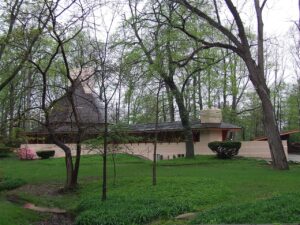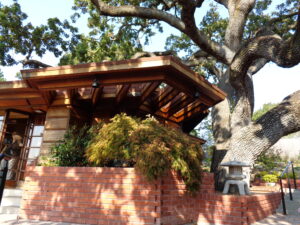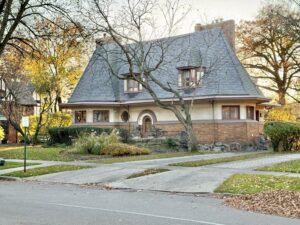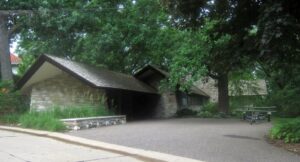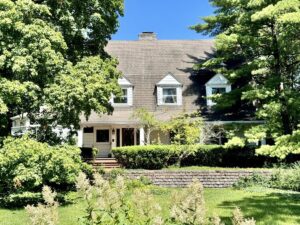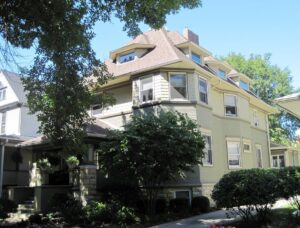
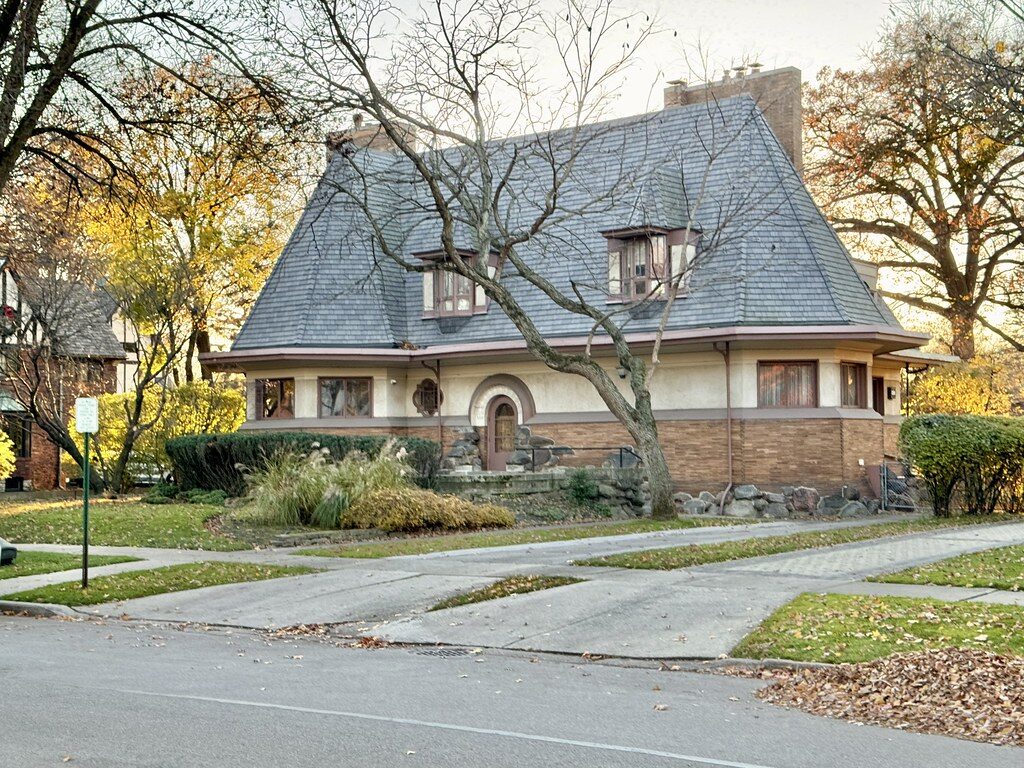
Located along Edgewood Place in historic River Forest, Illinois, the Chauncey Williams House represents a pivotal early milestone in Frank Lloyd Wright’s career. Designed in 1895—shortly after Wright left Adler & Sullivan to open his independent studio in Oak Park—this distinctive residence highlights the emergence of his Prairie School philosophy while celebrating organic harmony with its wooded surroundings.
Though often grouped visually with Wright’s early 1890s work due to its transitional features, the Williams House was a fully legitimate, official independent commission rather than one of his covert “bootleg” homes.
Real Estate & Market Status
The landmark Chauncey Williams House is currently on the market, presenting an extraordinary opportunity to acquire a pioneering work from Frank Lloyd Wright’s 1890s River Forest repertoire. Offering substantial living space across three levels on a scenic residential parcel, the home preserves signature original craftsmanship, including custom art glass, Roman brick masonry, and organic woodwork, while integrating updated home systems for modern living.
-
Bedrooms / Bathrooms: 5 Beds / 3.5 Baths
-
Living Area: ~4,200 sq. ft.
-
Property Status: Active Listing
-
Location: 530 Edgewood Place, River Forest, IL 60305
Key Information
| Attribute | Details |
| Location | 530 Edgewood Place, River Forest, Illinois (Cook County) |
| Designed / Built | Designed & Constructed 1895 |
| Architectural Style | Early Independent Practice / Transitional Japanese-Influenced |
| Designation | Contributing Structure, River Forest Historic District |
| Primary Materials | Roman brick, natural river boulders, cedar shingles, leaded art glass |
Architectural Significance & Unique Features
Designed shortly after Wright established his practice at his Oak Park Home and Studio, the Chauncey Williams House reflects the architect’s experimentations with pitch, materials, and nature prior to fully developing his low-slung Prairie style.
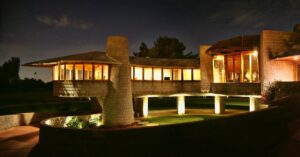
The house features a striking high-pitched roofline with flared eaves influenced by traditional Japanese architecture, a theme reinforced by Wright’s early fascination with Asian spatial design. In a dramatic gesture of organic integration, Wright framed the front entrance using large, unhewn glacial boulders retrieved directly from the nearby Des Plaines River bed—a deliberate attempt to anchor the man-made structure seamlessly into its local ecosystem.
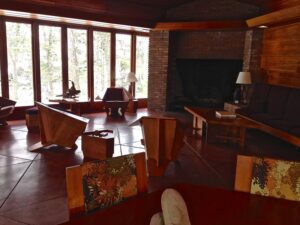
The foundation and lower exterior are constructed of narrow, horizontal Roman brick, emphasizing ground alignment. Inside, the home opens into expansive central living spaces configured around a massive masonry fireplace, with broad leaded art glass windows allowing filtered natural light to flood the interior millwork.
History & Background: Independent Practice vs. “Bootleg” Era
While the Williams House shares steep rooflines and experimental details with Wright’s infamous “bootleg” houses—the clandestine commissions he designed between 1889 and 1893 while under contract with Adler & Sullivan—it was built two years after Wright’s departure from the firm. Following his split with Louis Sullivan in 1893, Wright began taking on official, fully public commissions under his own name, making the 1895 Williams House an authorized triumph of his fledgling independent studio.
Chauncey L. Williams, a Chicago publisher and co-founder of the Way & Williams publishing firm, was a close personal friend and early patron of Wright. Williams shared Wright’s passion for fine book design, art, and craftsmanship. In 1895, Williams commissioned Wright to design this family home on Edgewood Place, just blocks away from Wright’s first major independent commission, the William H. Winslow House (1893).
The collaboration between Williams and Wright extended well beyond architecture: in 1897, the two men jointly hand-printed and published The House Beautiful, a celebrated limited-edition volume featuring text by William C. Gannett with custom photographic borders and graphic ornament designed directly by Wright.
Location & Viewing Context
Situated at 530 Edgewood Place, River Forest, IL 60305, the Chauncey Williams House is a private residential landmark within a walkable neighborhood renowned for its density of Prairie School design. Visitors exploring the River Forest Historic District can view the exterior from the public sidewalk while taking in neighboring works by Wright and his contemporaries.
Visitor Information & Nearby Accommodations
For architecture enthusiasts traveling to Oak Park and River Forest to view the Williams House, Winslow House, Unity Temple, and the Frank Lloyd Wright Home and Studio, several convenient lodging options are available within minutes:
- The Carleton of Oak Park: Nestled right within the historic district, this boutique hotel offers classic, refined accommodations just minutes from Wright’s Home and Studio. It provides a wonderful neighborhood feel with immediate access to local dining and the CTA Green Line into Chicago.
- The Harvey House Bed & Breakfast: For an intimate, luxury experience, this top-rated brick mansion B&B features beautifully appointed suites, cozy fireplaces, and a gourmet breakfast menu. It’s a perfect design-forward sanctuary for architecture enthusiasts looking to stay in the heart of Oak Park.